 |
There are so many rewards and benefits that our credit cards offer. Are you maximising your full benefits? Here are tips to get the most of your credit cards.

We talk a lot about credit cards here on RinggitPlus and for good reason. They're an easy way to build good credit history, a handy way to keep track of our monthly expenses, and plenty of them offer great rewards.
That being said, there may be times when we haven't really exploited all we can from what these cards offer us. Here are some tips and tricks to squeezing out every bit of rewards from your credit cards.
Pick a Credit Card That Fits Your Lifestyle
Just because some cards offer great rewards, doesn't mean your spending habits will get those rewards to you. So when choosing a credit card, be sure that what the card rewards you for things you're already doing. It doesn't make sense to get a travel-rewards card when you don't even have a passport now, does it?
Pay Attention to the Annual Fee
If you can, it's always best to pick a card that has no annual fee in the first place. However, even if you already have an annual fee attached to your credit card, try calling the bank to see if you can get it reversed. Certain banks may waive the annual fee if they deem that you swipe enough on the card already (subject to various bank policies and approvals).
 Check Your Card's Hidden Perks
We've covered the importance of lesser-known credit card perks before, but it's worth repeating. Things like purchase protection, complimentary insurance, and the like might be benefits that your card already covers so take advantage of these whenever possible.
 Get Apps to Help You Find Credit Card Deals
Mobile apps like CIMB Deals or the Maybank2U app let you search around for merchants that offer additional reward points, cash back, discounts or goodies when you swipe your card. These come in super handy to optimise your rewards earnings.
Switch Out Your Cards for Different Rewards
Since different cards offer different rewards, rotating your cards to use for different purposes helps to maximise your benefits even more. Have a petrol card for refueling, one for groceries, etc.
Don't Forget To Use Your Rewards and Points
Some rewards expire, so don't sit on them too long and check up regularly to know if there are any free privileges of discounts you're missing out on.
 Streamline Your Rewards
Certain credit cards allow you to choose the kinds of rewards you get, whether it's air miles, points, or cash back. Call up and check to see if they have this on your card, and if they do, adjust it such that the rewards you get will be the type you'll reap the most benefits from.
Great rewards from credit cards mean nothing if you can't exploit them to their absolute maximum, and we hope our tips can help.
Do you have your own credit card rewards-maximising tips? Share them with us in the comments section down below!
|
Wednesday, September 20, 2017
Tips to Milking Your Credit Cards for Every Last Reward

Friday, September 15, 2017
Take Immediate Action When You Experience These Credit Card Issues

Credit cards make our life easier and it is lighter to carry around. However, we have to also be careful with our credit cards especially with fraud and theft on the rise these days.
You might encounter these issues with your credit cards in the near future and it is not to be taken lightly or you might lose more than you think.
8 Common Credit Card Problems and Steps to Fix Them
1. Lost Your Credit Card
It is common to lose your wallet these days whether to theft or carelessness. However, you might be surprised at how quick a person can use your credit card to exploit your finances if you do not take immediate action.
The culprits can swipe at stores or branded outlets to wipe out your credit so they can sell those items later on.
What to do: Contact your bank immediately to eliminate the stolen card and request for a new one.
2. Unknown Transactions
Here’s a reminder: Remember to monitor your credit card transaction regularly so you can identify any unknown or suspicious transactions and take action immediately. Fraud or identity theft can occur when the thieves somehow get your credit card number when you were not paying attention and used it to shop online.
Most banks will send an SMS to notify every transaction by a credit card or debit card, hence, pay attention to the SMS to avoid any fraud or theft case.
What to do: Contact your bank immediately and verify the transaction. If you did not conduct the transaction, you should provide the bank information such as evidence or proof to show that you were not in the shop or outlets when the transaction was made.
3. Credit Card Is Declined
If your credit card is declined at any shop or digital sites, it is possible that you have not activated your credit card. However, there are other possibilities such as malfunctioning chips or an exhausted limit. You must find out the real problem behind the malfunction so you won’t be stuck or confused when you need to use your credit card again.
What to do: Check if you have reached your credit limit. If not, visit the nearest bank branch and request for a check on your card. You will usually get a faster solution if you visit the bank branch.

4. Erroneous Charges
If you experience an error in charges like double charges or a wrong value from your recent transaction using a credit card, you must ask the outlet or shop to void the bill if it is within the same day. If it has been more than a day, you will need to keep the receipt and contact your bank to take further action to correct the transaction. Everyone makes mistakes including retail stores and machines.
What to do: Keep your receipt for at least one week. Check your credit card statement after every transaction (which usually takes one day to update) so you can take action early if necessary.
5. Incorrect Details on Your Card
When you have incorrect data on your cards, such as a misspelt name, most retail stores are likely to refuse to take your credit card as it appears dodgy. To protect yourself in the future from identity theft cases, you need to ensure all the information is correct on your credit card.
What to do: Always check your information on the card when you receive a new credit card. Contact the bank or visit the branch nearby for immediate correction if applicable.
6. Receive A Bill When Credit Card is Not Activated
This is mostly a fraud case where someone could have broken into your mailbox and may have stolen your credit card which could hurt your credit badly if you do not respond immediately. It usually takes around two weeks to receive your new credit card. When you do get it replaced, remember to activate your credit cards or keep it in a safe place to avoid fraud or theft.
What to do: Contact your bank right away and tell them every detail of your encounter. Stay calm and follow the instruction from the customer service team. Usually, they will verify your information and request for your permission to cancel the card so they can send a new one. Remember to ask them to void the transaction that was made.

7. Overwhelming Credit Card Debts
This might not be a fraud or theft case but the impact is just as huge as getting one. Many Malaysians continue to underestimate the power of interest rates (18% for most credit cards) resulting in piles of huge debts. This is a huge setback for those who seek to achieve financial freedom or certain goals such as buying a house.
Did you know 12.8% of Malaysia’s credit card holders are not even paying the minimum 5% outstanding payment? According to Statistic Department Malaysia, Malaysians have a total credit card debt of RM36.9 bil as of this year and 835 of them have declared bankruptcy because of their inability to repay debts.
What to do: Stop spending recklessly and start looking at ways to consolidate your debt by starting from the one with highest interest charges (credit card usually). Take advantage of debt consolidation personal loan or balance transfer plan to cut down your debt.
8. Your Credit Report Carries Inaccurate Information Of Your Credit Card Payment/Outstanding
If your credit report does not project the exact information such as the outstanding amount or payment pattern, you must contact the credit agencies immediately (CCRIS and CTOS). If the wrong information persists on your credit record, you may suffer from not being able to apply for a new loan or credit card in the future.
What to do: Contact the credit agencies to request for a correction. Provide your bank statement and any other documents to support your claims.
If you have any question regarding to your credit card, please drop them in the comment section below!
Wednesday, September 13, 2017
Always Use Your Credit Card to Pay For These 8 Things
Some transactions are best done with a credit card for extra security and special perks. Swipe yours when paying for these goods and services!
Paying with cash is quick, easy and (usually) accepted everywhere. But your paper money, coins, debit cards and online bank accounts can sometimes fall short when compared to credit cards. This is because the latter is often accompanied by special perks, more so even, for certain product categories.
Here’s a list of stuff that you should always pay for with a credit card whenever possible to enjoy rewards, protections and warranties that would otherwise be unavailable to you with plain old cash.
1. Utility Bills
Some credit cards offer rebates, discounts and a chance to accumulate reward points when you pay for utilities like cable and phone bills with your card.

It’s easier to rack up rewards with recurring payments (that you were going to make anyway) and moreover, automatic deductions can save you from paying late penalties.
2. Big-Ticket Items
Throwing a wad of cash around to buy expensive, heavy -duty items is neither convenient nor safe. Choosing to pay with a credit card on the other hand, might get you a complimentary purchase protection plan to insure your buys against theft or damage.

In addition, some credit cards can further secure your purchase with an extended warranty as well.
3. Online Purchases
When choosing between a debit card, online bank account, and a credit card to pay for online purchases – it’s always best to go with your credit card. This is because of the protections in place to protect credit cardholders from fraud.

While debit cards and online banking are also relatively safe options, getting your money back is not always likely if fraud has occurred. Conversely, credit cardholders typically enjoy limited liability when fraudulent activity is reported immediately.
4. Travel Tickets
If you have a credit card that comes with travel insurance, you might be able to take advantage of travel inconvenience benefits. Expenses arising from lost luggage, delayed flights and losing your accommodation bookings as a result, can be claimed with travel insurance.

Some cards also offer medical and personal accident insurance to provide hospitalisation and healthcare coverage as you travel.
5. Concerts and Events
Paying with your credit card for tickets to events can save you in refund fees and sometimes even provides insurance in case concerts are cancelled.

You may also receive special ticket discounts, access to pre-sale tickets, booking fee waivers and free delivery of tickets when you buy them with your credit card.
6. Electronics
When credit card companies and merchant agreements offer zero-percent instalments, you’ll have the option to buy quality and sometimes pricey electronics in affordable instalments at no cost to you. This way you can keep your savings and reserves intact without having to make a chunky withdrawal.

You may also find that some credit cards provide extended warranties that will save on repairs and satisfaction guarantees that make it easier to return or get refunds on items that end up not performing as promised.
7. Overseas Buys
Just like online purchases, it’s best to use your credit card for overseas buys due to better fraud protections. Moreover, your card could enjoy very low foreign transaction fees, which are calculated as a percentage (one to three percent on average) and not a flat fee.

Thus, these charges can be rather high if the item you are buying is expensive. In addition, certain cards also earn you more reward points for foreign transactions.
8. Tax-Deductible Items
Credit card bills tend to be itemised and statements are typically available in soft and hard copies, making this payment method the easiest way to track your tax-deductible receipts.

Swiping your credit card for books, sports equipment, life insurance premiums, donations, computers and other tax-deductible buys can save you a bit of hassle when filing taxes later on.
While credit cards sometimes get a bad rep for debt accumulation, using yours responsibly can actually provide more value in addition to protecting your purchases. Remember however, to only charge items that you can pay off.
Sunday, September 10, 2017
6 Money Lessons You Can Learn from Game Of Thrones

The new season of Game of Thrones is here and the Internet is all abuzz about what’s happening in Westeros! But did you know there are some important financial lessons from Game of Thrones? Read on to find out more…

Beware the folly of kings.
Remember House Baratheon? Robert took the throne of the Seven Kingdoms of Westeros after a successful rebellion and proceeded to neglect his duties as a king and alienated his closest advisors up until the point of his untimely death. Everything he fought so hard was undone due to his carelessness in ruling his kingdom and left us with The War of Five Kings.
His son, Joffrey ultimately fared no better and proceeded to make himself the most hated person in Westeros (and to audiences across the world) as a tyrant who then ended up on the wrong end of a poisoned wine goblet.
Stay grounded and be fully committed to managing your finances at all times and never let yourself be manipulated into living beyond your means. Don’t let yourself be taken in by short-term successes like these two failed kings.
Build a legacy that lasts, “Winter is coming”.
Look at Tywin Lannister, despite his extremely dysfunctional family and ungrateful children; he was always obsessed about creating a legacy that would last. In his eyes, every decision he made was always for the greater good of house Lannister. Unlike Robert Baratheon, whose goals were too short-sighted and eventually turned into dust, Tywin was always planning one step ahead to ensure his family’s interests were well protected. Well, right up until he took a crossbow to the stomach courtesy of his son Tyrion, of course.
And of course with the constant reminder that “Winter is coming” (thanks Jon Snow), it doesn’t help to always think ahead and be prepared.
The years will fly by quickly and before you know it, you might find yourself facing retirement. You should always be working towards building a financial legacy that you and your family can depend on in your retirement years. But don’t forget to enjoy life as well because you never know what might happen in the future.
Always pay your debts.
As the saying goes, “A Lannister always pays his debts.” We’ve seen Tyrion and Jaime live up to this saying several times in the Game of Thrones series by paying off anyone they owe coins or favours to. And while we’re pretty sure that the saying also means that any attempts at backstabbing or murderous plots against the Lannisters will be harshly dealt with in kind, that doesn’t mean we can’t apply it to a real life financial lesson! After all, who doesn’t want to be “Rich like a Lannister”?
Don’t let your debts spiral out of control and make sure you know the difference between good debt and bad debt. You don’t want to be working yourself to death by paying high-interest charges on your credit cards, so learn to manage your debts wisely.

Photo credit: HBO
Never borrow more than you can repay.
Think about the Battle of the Bastards and remember how, right when you thought all hope was lost, Sansa and LIttlefinger appear with the Vale army to help Jon Snow defeat Ramsay Bolton? Sansa Stark must have known that this favour was not for free – in fact, Littlefinger made his advances and his intent of sitting next to her on the throne even clearer.
It also reminds us of the saying “never bite off more than you can chew”, be very aware of your financial appetite and your budget before you land yourself in excessive debt. We should aim to achieve our financial goals, not burden ourselves with debt that could potentially lead to bankruptcy.
A healthy debt to income ratio is around 30%, this means that you utilise 30% of your monthly income to service your debts. A higher debt to income ratio means you could be in excessive debt which prevents you from reaching your financial goals, like saving for retirement.

“The Iron Bank will have its due.”
On that note, here’s another saying that you can hear whispered in the shadows of the Seven Kingdoms. In season one, we discovered that Westeros was heavily in debt to the tune of several million gold Dragons to the Iron Bank of Braavos. Not only are they the most powerful banking institution in the world of Game of Thrones, they are known for not messing around when it comes to collecting on their what’s rightfully owed to them.
When Cersei Lannister refuses to repay Westeros’ debts, their immediate reaction was to freeze all outstanding loans and switch allegiances to Stannis Baratheon and start funding his armies instead. Which as you can tell, doesn’t bode well for the longevity of Westeros’ ruling house.
Paying off your bills or debts that you owe to banks, financial institutions or anyone else for that matter is extremely important. Not doing so will jeopardise your chances of getting a loan in the future as you will have an extremely poor credit history. With CCRIS and CTOS reports readily available to the banks in Malaysia, this could even affect your chances of buying that dream home, sports car or even getting a credit card!
Good things come to those who wait.
Daenerys Targaryen has had it rough, what with her psychotic older brother and family’s history of having a tendency to go insane. Not only did she get married off as a political move, her warlord husband Khal Drogo soon ended up dead, due to a plot by someone Daenerys had initially trusted. But Daenerys persevered and made strategic alliances of her own which put her at the head of an army with not one, but THREE dragons.

Photo credit: HBO
Talk about a spectacular comeback for someone who had already been written off by her enemies.
It’s hard not to be disheartened when you’re faced with what seems like a mountain of debt that you can’t overcome. The point is, always be patient and persevere through whatever challenges your financial situation may bring. If you need help, don’t be afraid to reach out to organisations like AKPK and tackle your financial challenges head on. Baby steps will lead you to giant strides.
Friday, September 08, 2017
The Best Public Transport To Get Around In The Klang Valley

About 1,000 cars are registered daily in Kuala Lumpur alone, which is why the roads today have been increasingly congested. A survey found that traffic congestion in the Malaysian capital was up by 34%.
It’s so bad that Malaysians have complained of being stuck in traffic for so long that it’s become the worst part of their day.
So it goes without saying that the best option here is to look for other modes of transportation. The good news is in the last few years, we’ve seen an upgrade on major rails and links with new laws being passed for ride-sharing services. But with such an intricate system, where does one start?
Fret not, we’ve got you covered. Below, we break down the cost and time it takes using these services so that you’ll have it easier the next time you traipse across the Klang Valley.
Trains
Rail transport in Malaysia consists of heavy rail, light rapid and mass rapid (transit), and monorail. There’s also the airport rail link and a funicular railway line.
1. KTM Komuter
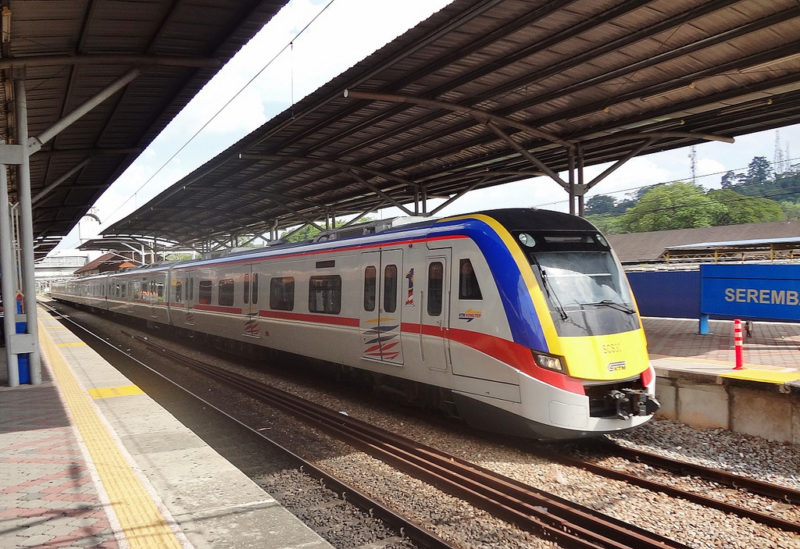
Image from Encyclopedia.com.my
Introduced in 1995, the KTM Komuter provides local rail services in Kuala Lumpur and the surrounding Klang Valley suburban areas. The KTM is commonly used by the locals as it reaches a lot of key areas from Klang right up to the neighbouring state of Negri Sembilan.
Tickets and fares
Tickets are sold at counters and through vending machines available at all stations and halts. Fares start as low as RM1.20 and can go up to RM21 per trip, depending on the location. For detailed schedule, visit the KTM Komuter page.
A one-way ticket to Mid Valley Mega Mall from Subang Jaya, or vice versa, would cost RM3.20, while fares from KL Sentral to Seremban would cost RM9.20 one-way, which is pretty affordable.
Pros and cons
|
|
The KTM has one of the biggest reach in terms of intercity stations, as it goes all the way to Negeri Sembilan. It’s ideal for people living in the suburbs, especially in reaching the city centre.
But it does have a reputation of having technical issues where the trains would stop midway, causing plenty of delays and missed appointments for many. So it’s not the best option if you’re in a rush.
2. LRT & MRT
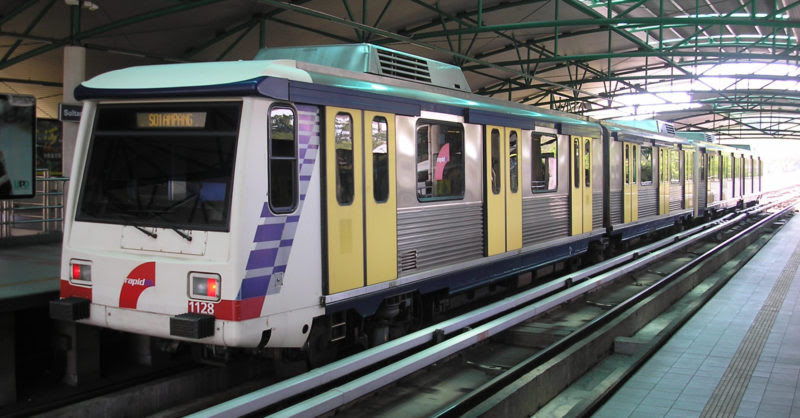
Image from Campus Malaysia
The LRT and MRT are extensive light and mass-rapid train systems and will be continuously growing for years to come. The current lines for the LRT are mainly the Kelana Jaya Line (formerly known as PUTRA) and the Ampang Line (formerly known as STAR), which began operation in the 1990s.
In 2016, both lines were extended to cover more areas within Subang Jaya and Putra Heights, giving a total of 73 stations, with two more reserved to be used in the future on the Ampang line.
They have a combined ridership of 160 million as of 2017, making it one of the most popular modes of public transport in Malaysia!
The MRT is a newly developed rapid transit that span from Sungai Buloh to Kajang. As of July 17, 2017, there are 31 stations that cover areas such as Bandar Utama, Mutiara Damansara and TTDI with three more stations planned in the future.
More lines are expected in the future to reach areas such as Putrajaya and Cyberjaya, so watch out for those!
All of these trains are connected at various stations, with KL Sentral being the most popular due to having all the lines within or nearby the station. There’s also Masjid Jamek, Pasar Seni and Subang Jaya (for those taking the KTM) as other exchange areas to look out for as well.
Tickets and fares
Tickets are sold at all the stations via the counter and machines available. Tickets are as low as RM0.80 and as high as RM9.70 one-way depending on where you’re going. For detailed information, you can check out the RapidKL website.
If you’re taking the MRT from TTDI to KLCC LRT station, you will need to pay RM4.30 but you will have to change stations at Pasar Seni.
Thankfully, there’s no extra payments during the exchange and you will just need to walk to the station! But if you’re taking the LRT all the way to KLCC on the same Kelana Jaya line from Bangsar, it will only cost RM2.70 per trip.
Pros and cons
|
|
During non-peak hours, the wait can last up to seven minutes, which may not mean much if you’re not in a rush but the opposite for those on a tight schedule.
And while most of the interchanges do not require you to change tokens, there are some where you are required to. For example, if you’re changing from the LRT at KL Sentral to either the monorail or MRT, you will have to walk from the main station to the monorail or MRT station, and you will also need to purchase new ticket or token at the respective station.
3. Monorail
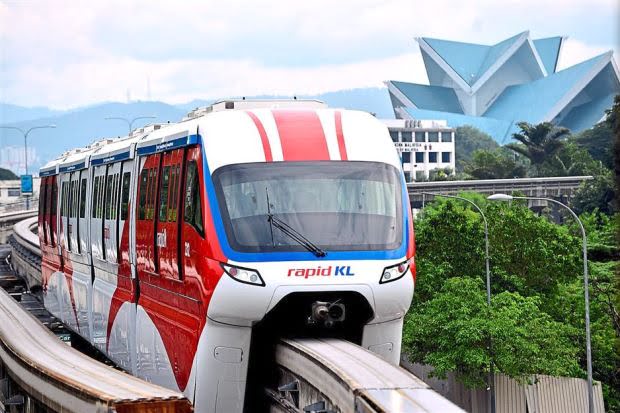
Image from The Star
The Kuala Lumpur monorail opened in 2003 and links areas within the centre of Kuala Lumpur that were not served by the other urban rail systems. It’s the best train to use within the city centre with 11 stations, connecting areas such as Bukit Bintang, Sungai Wang, Berjaya Times Square and more. The monorail is also under the RapidKL, which means it is possible to do interchanges to other trains at certain monorail stations.
Tickets and fares
You can purchase monorail tokens over the counter or at the machines in the station. The price ranges from RM0.90 to RM6.70. For fares for a specific destination, check the RapidKL website. Ticket from KL Sentral to Bukit Bintang would cost RM2.50 one-way.
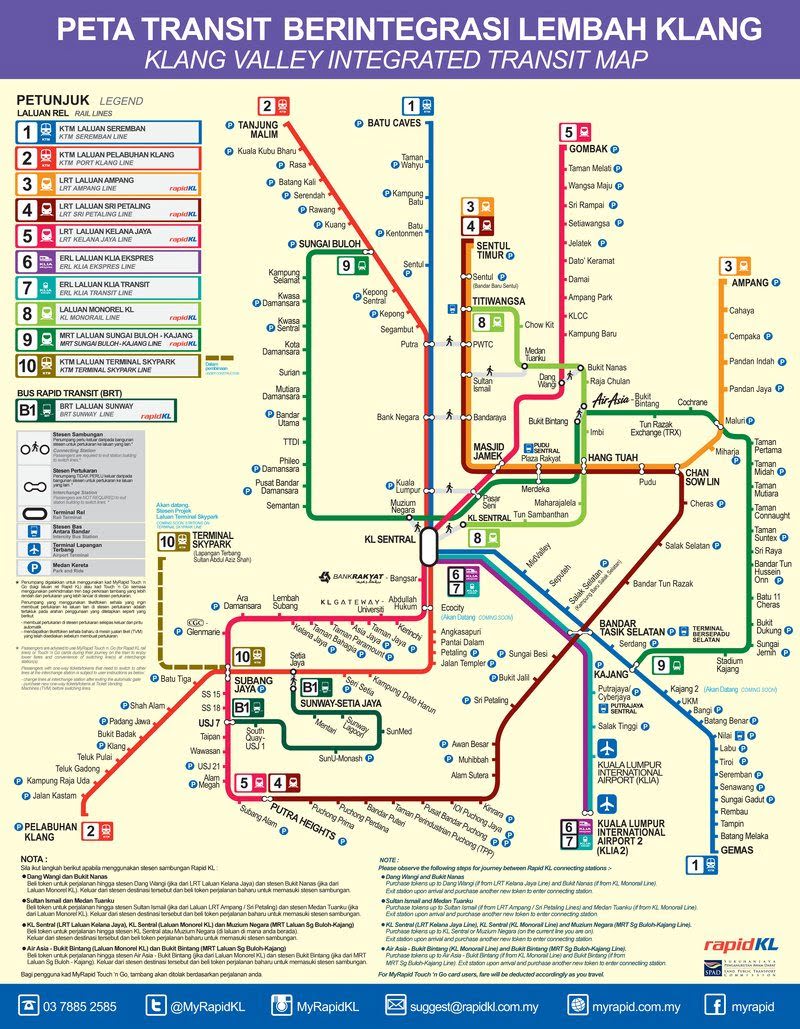
Map of train lines available in the Klang Valley
Pros and cons
|
|
The monorail is perfect for tourists who would like to explore the city centre as it covers key areas such as Bukit Bintang and Chow Kit. However, the monorail trains are a lot smaller in comparison to the LRT and MRT, which means it can get overcrowded easily.
Buses
Before trains, the only public transport available (other than taxis) were buses. Unlike the olden days of having mini buses that could get into smaller roads and more neighbourhoods, the buses today are bigger and have a wider reach compared to before. There are even electric buses on the road today! So, here’s what you need to know.
1. RapidKL Bus & MRT Feeder Bus
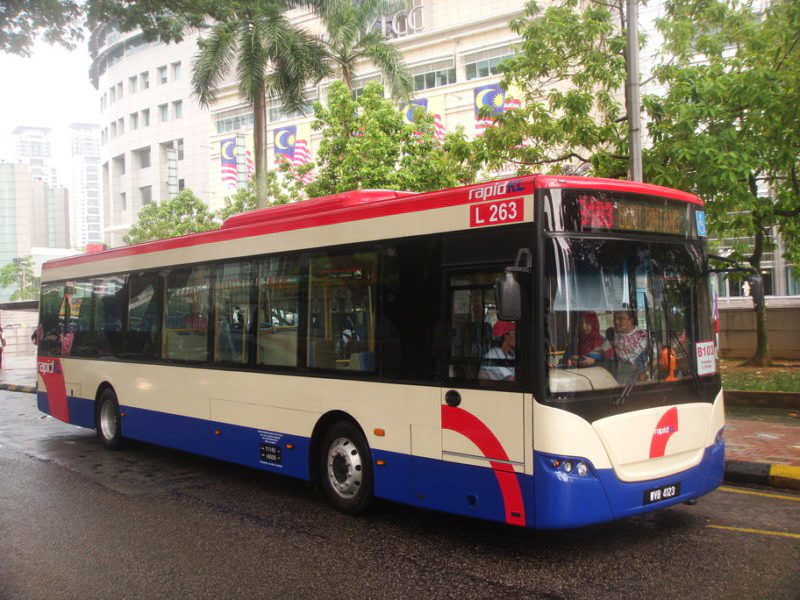
Image from Wikimedia Commons
Today a majority of the buses are operated by RapidKL and the MRT Feeder buses. The RapidKL buses cover areas from Ampang and Cheras, to Damansara and Puchong.
These buses have a wider reach and will also have a stop at a nearby LRT or MRT station if you need to get to one. But they stop at many popular places that are not linked by trains such as shopping malls and recreational centres.
The MRT Feeder Bus’s goal is to help people get to the closest MRT station with ease. As not everyone can live close to the MRT station, these buses aim to bridge that gap for those who would like to use the MRT.
Tickets and fares
The bus driver will take both payments of cash and Touch n Go, though it’s advisable to have exact change. Depending on where you’re going, the fares can cost from RM1.00 to RM5.00. Check your fares on RapidKL website. A bus ride from SMK Taman Tun Dr Ismail to the Bandar Utama MRT will cost RM1.00, if you are paying by cash.
Pros and cons
|
|
Buses are the most affordable mode of transport among all public transportation,
However, be prepared to brace traffic jams just like all other road users. And they have a reputation of not being punctual, which can be frustrating if you’re in a rush.
2. BRT
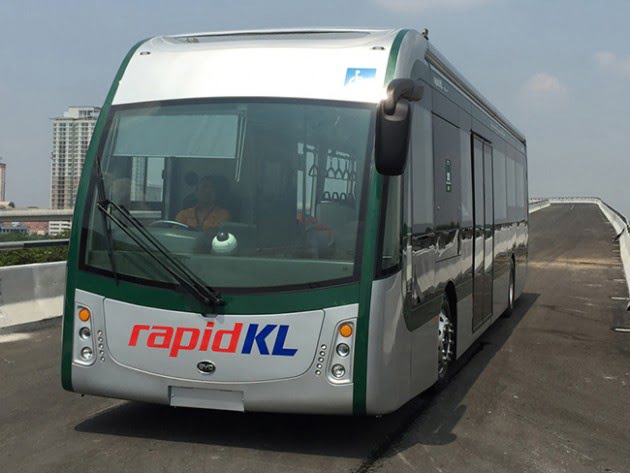
Image from Says.com
The BRT is a special closed bus system where they have an elevated guideway that does not use the same road as other vehicles — this means they are spared from the nightmarish traffic congestion that we see everyday. They also use battery-run electric buses instead of the usual buses.
There is only the Sunway Line for now, which covers the popular theme park, Sunway Lagoon and shopping mall, Sunway Pyramid. It currently only has seven stations, but more BRT stations are set to be built in the future.
Tickets and fares
As they share the same line as the LRT, you can buy a ticket at the combined LRT station (which is the USJ 7 LRT station currently) and at the other BRT stations. They’re available at the machines and over the main counters of each station. If you take the BRT from the USJ 7 LRT station to go to Sunway Lagoon station, it would cost RM4.00.
Pros and cons
|
|
Because the BRT uses an elevated track for only BRTs, there’s no issues with delays or being stuck in traffic. But this is also why the BRT can be pretty expensive compared to the other trains and buses. The higher cost is also due to its high maintenance and initial cost of the system.
Taxis
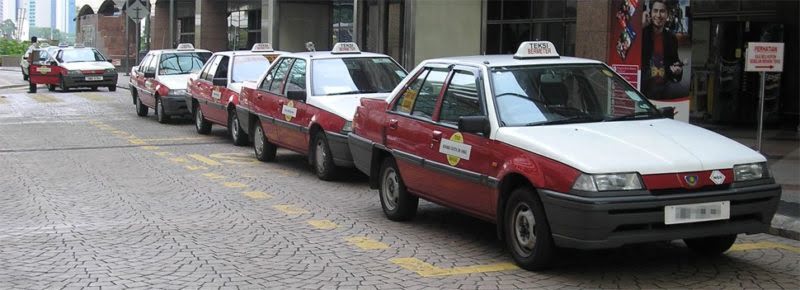
Image from KLIA2
Malaysian taxis are easily available around the Klang Valley, making it a great go-to option when you need transport ASAP. They (typically) use meters to calculate the overall cost of your transport, and these calculations also depend on the type of taxi you get.
The difference in these taxis are that they offer different levels of comfort and space. The budget taxis are smaller and are the best for transporting up to four people and medium-sized luggage and baggage. The TEKS1M and Executive Taxis are bigger and they can transport up to six people and/or carry more luggage.
Fares and fares
The cost of a taxi depends on the type of taxi, distance and time it takes to reach your destination. Here’s how the current calculations are done for these three common taxis:
| Taxis | Initial fare (Inclusive of 1st km or first 3 minutes) | Subsequent distance | Subsequent time |
|---|---|---|---|
| Budget Taxi | RM3 | RM0.25 / 200m | RM0.25 / 36sec |
| TEKS1M | RM4 | RM0.30 / 200m | RM0.30 / 36sec |
| Executive Taxis | RM6 | RM0.20 / 100m | RM0.20 / 21sec |
Here’s an example of how taxi fares are calculated: The initial cost of a budget taxi (inclusive of the first KM or first 3 minutes) would be RM3 and would go up by RM0.25 for every 200m or for every subsequent time of 36 seconds.
For example, a 15-minute budget taxi ride with smooth traffic from KLCC to Mont Kiara could be around RM16.45. However, if you find yourself in slow traffic, you could see yourself paying up to RM20 and more.
There are also additional costs to look out for such as an additional 50% for trips between midnight and 6am, an additional RM2.00 for advance phone booking, and you even have to pay for toll charges unless you book your taxi using authorised coupons.
If you’re trying to get a taxi to and from the airport, the price ranges as well though they are set depending on the different zones. A budget taxi from the airport to the city centre of KL could cost around RM80 or more, and the cost will depend on the type of taxi you get as well.
Pros and cons
|
|
Taxis are useful as they’re more easily available in areas that you may not get other public transportations.
Even with the occasional drivers who haggle, Malaysian taxi fares are still among the most affordable in the world!
E-hailing services
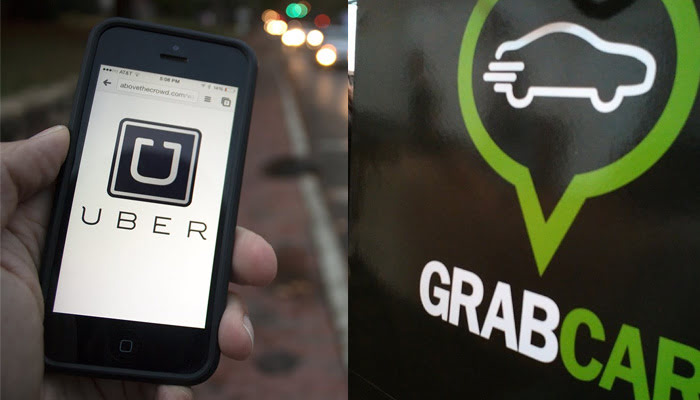
Image from efrennolasco
Want to reach your destination comfortably without having to spend a lot? Then e-hailing services is the way to go. Now that e-hailing services are legal in Malaysia, it’s commuters’ favourite way of getting around in the Klang Valley.
Currently the big names in e-hailing services are Uber and Grab (formerly known as MyTeksi). While they are the same in many ways, they have distinct differences, such as:
|
|
Regardless of your choice, you will need to download their app on your smartphone and register in order to use their service. You will also need an internet connection when booking an e-hailing service, so all of this will need to be considered if you do not have a Wi-Fi connection or mobile data. As long as you have the app and your phone is connected to the internet, getting a driver is simple and fast.
Fares and charges
The best part about e-hailing services is that rates are often fixed, so you don’t have to worry too much about having to pay more than the expected fare stated. But you may be paying more than usual if the service is in high demand or due to traffic, but the surged prices will be shown when you are booking the ride.
Economy | ||
|---|---|---|
| Base Fare | RM0.95 | RM1.00 |
| Per KM Rate | RM0.60 | RM1.30* |
| Per Minute Rate | RM0.25 | RM0.00 |
For example, if you’re living in TTDI, taking any e-hailing service to KLCC, it would cost about RM13 to RM18. But when there is a high demand, it could cost over RM20. The fares do not include any toll charges incurred.
The trip would take about 20 minutes (depending on traffic), and would likely still be a lot more affordable than taking a taxi. On the plus side, you do have the option of either paying via cash or credit card, so you don’t have to worry too much about having enough change.
Pros and cons
|
|
E-hailing services are incredibly popular these days, especially since they come with frequent promotions that could make your rides more affordable. Grab now comes with reward points with every ride you take, which you can accumulate and redeem in other ways such as free rides or even discounts at certain stores or restaurants.
They also get you to the place that you want as fast as a taxi for a lower price. But if it’s peak hour or if it’s in high demand, the cost can be as much as taking a taxi, or even more. If the driver who accepted your request is further than expected, you may see yourself waiting up to 10 minutes, and if it’s the same cost as taking a taxi, it’s a loss on your part.
The best way to optimise your transport experience
Image from The Star
While taxis and e-hailing services allow you to pay by cash or credit card, almost all of the available public transport encourage you to use a Touch n Go card. Not only is it the most convenient payment option to use across all platforms, it also gives you cheaper rates compared to using a token!
A Touch n Go card costs RM10 and can be bought at any train station. You can fill it up with as much credit as you would like and use it across all the different trains and buses around in Malaysia. That bus trip goes down from RM1.00 to RM0.80 when you use a Touch n Go card. A trip from Bangsar LRT to KLCC LRT would cost RM2.70 if you purchase a token by cash, but using a Touch n Go card would only cost RM2.40. Taking the MRT from the TTDI station to the KLCC LRT station will cost RM3.80 using a Touch n Go card, but cost RM4.30 with cash.
You can also sign up for special packages with the RapidKL Touch n Go card, which will give you even more savings. Like that trip from Bangsar LRT station to KLCC LRT station would cost RM2.30 with the MyRapid SMART30 package.
The downside to the Touch n Go card though, is that reloading may cost you RM0.53 service charge when you do it over the counters in the train stations.
Here are some places you can reload your Touch n Go with no reload fees:
- Selected shops or pharmacies
- Touch n Go reload machines
- CIMB ATM
- Tambah nilai toll booth
- Touch n Go customer service
- Selected petrol stations
For the full list of places to reload your Touch n Go with no reload fees, go to Touch n Go website.
If you’re figuring out how to make the transitions between trains and buses, you can use RapidKL’s Plan My Journey website to help you prepare for your trip. You can select your current location and your destination, and it will show you which transport to take, how long it will take and an estimated fare. For the e-hailing services, look for promo codes to save on your fares.
Choosing the best mode of public transportation can be a challenge, but it all boils down to your level of comfort, security and budget. You can always mix and match the options above to make your travel experience comfortable and within your budget. For example, if waiting for a bus isn’t for you, consider taking Uber, Grab or taxi to bring you to the closest train station.
With all of these options, you’re bound to find the one (or many) type of transportation that suits you the most. So, go out there and explore the Klang Valley the best way you like!
Subscribe to:
Posts (Atom)